Some more examples illustrating our three combinatorial interpretations of q-rationals
21 avril 2026 | Catégories: math | View CommentsLast November, with my colleague Jean-Christophe Aval in Bordeaux, we posted our preprint \(q\)-analogs of rational numbers: from Ostrowski numeration systems to perfect matchings on arXiv.
I recall that previous combinatorial interpretations proposed by Morier-Genoud and Ovsienko following previous work by Çanakçi and Schiffler and others were restricted to rational numbers larger than 1. The three combinatorial interpretations that we propose work for all positive rational numbers.
The three compatible combinatorial interpretations of the \(q\)-analog of rational numbers is explained by the following corollary stated at the end of the introduction of our preprint.
Corollary E. Let \(x>0\) be a positive rational number whose even-length continued fraction expansion is \(a=[a_0;\dots,a_{2\ell-1}]\). Then, the set \(\mathcal{B}(a)\) of admissible sequences for \(a\), the set \(\mathcal{M}(x)\) of perfect matchings of the snake graph \(\mathcal{G}(x)\) and the set \(\mathcal{J}(x)\) of order ideals of the fence poset \(\mathcal{F}(x)\) give three enumerative interpretations of the Morier-Genoud--Ovsienko \(q\)-analog of the rational number \(x\):
\( \left[x\right]_q = \frac{q^{-1}\sum_{b\in \mathcal{B}^\bullet(a)} q^{\Vert b\Vert_1}} {\sum_{b\in \mathcal{B}^\circ (a)} q^{\Vert b\Vert_1}} = \frac{q^{-1}\sum_{I\in \mathcal{J}^\bullet(x)} q^{\vert I\vert}} {\sum_{I\in \mathcal{J}^\circ (x)} q^{\vert I\vert}} = \frac{q^{-1}\sum_{m\in \mathcal{M}^\perp(x)} q^{area(m\Delta\mathfrak{b})}} {\sum_{m\in \mathcal{M}^\parallel (x)} q^{area(m\Delta\mathfrak{b})}} \)
where \(\mathfrak{b}\) is the basic perfect matching of the snake graph \(\mathcal{G}(x)\) and the fractions on the right-hand sides are reduced.
The numerator and denominator above are deduced from partitions of the sets of admissible sequences, of order ideals and of perfect matchings of snake graphs into two: \(\mathcal{B}(a)= \mathcal{B}^\circ(a)\cup \mathcal{B}^\bullet(a)\), \(\mathcal{J}(x)= \mathcal{J}^\circ(x)\cup \mathcal{J}^\bullet(x)\), \(\mathcal{M}(x)= \mathcal{M}^\perp(x)\cup \mathcal{M}^\parallel(x)\). For example, the partition or the set of order ideals \(\mathcal{J}(x)\) of the fence poset \(\mathcal{F}(x)\) is defined according to the presence or the absence of the first element 0 in the order ideal:
\(\mathcal{J}^\bullet(x) = \{I\in\mathcal{J}(x) \mid 0\in I\}\),
\(\mathcal{J}^\circ(x) = \{I\in\mathcal{J}(x) \mid 0\notin I\}\).
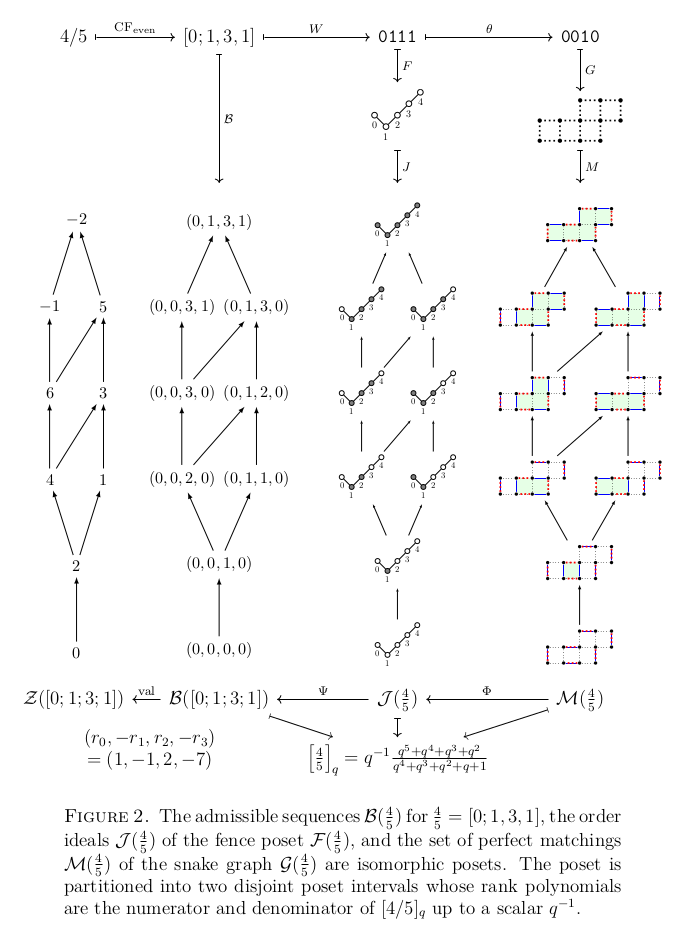
At the end of the introduction of our preprint, Figure 2 shows an illustration of our three combinatorial interpretations for the q-analog of the rational number 4/5
\(\left[\frac{4}{5}\right]_q = q^{-1}\frac{q^5+q^4+q^3+q^2}{q^4+q^3+q^2+q+1}\)
which is reproduced below:
The number 4/5 is just one very small example. But our result works for all positive rational numbers.
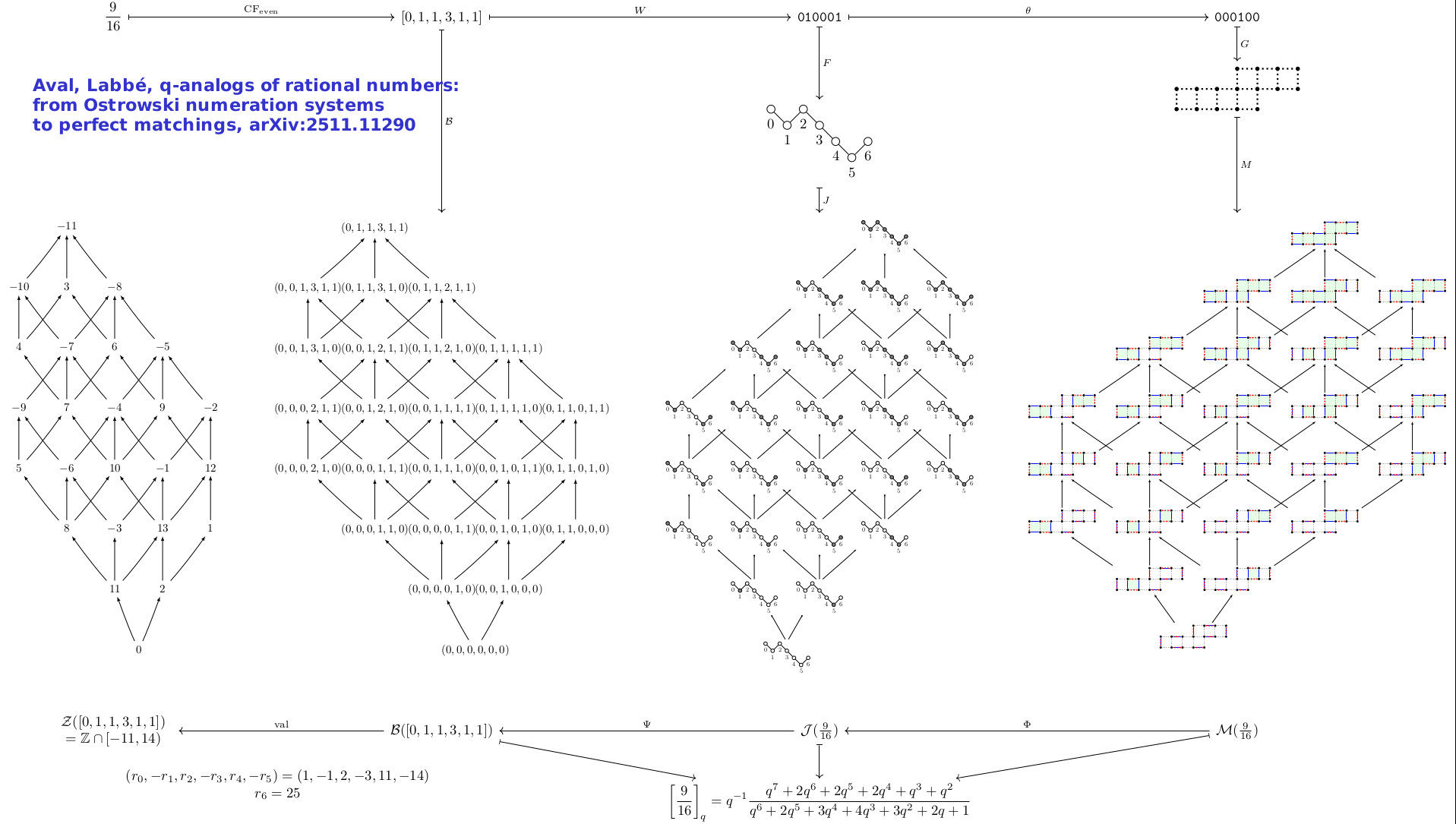
Here is the same Figure made for 9/16:
\(\left[\frac{9}{16}\right]_q=q^{-1}\frac{q^{7} + 2q^{6} + 2q^{5} + 2q^{4} + q^{3} + q^{2}}{q^{6} + 2q^{5} + 3q^{4} + 4q^{3} + 3q^{2} + 2q + 1}\)
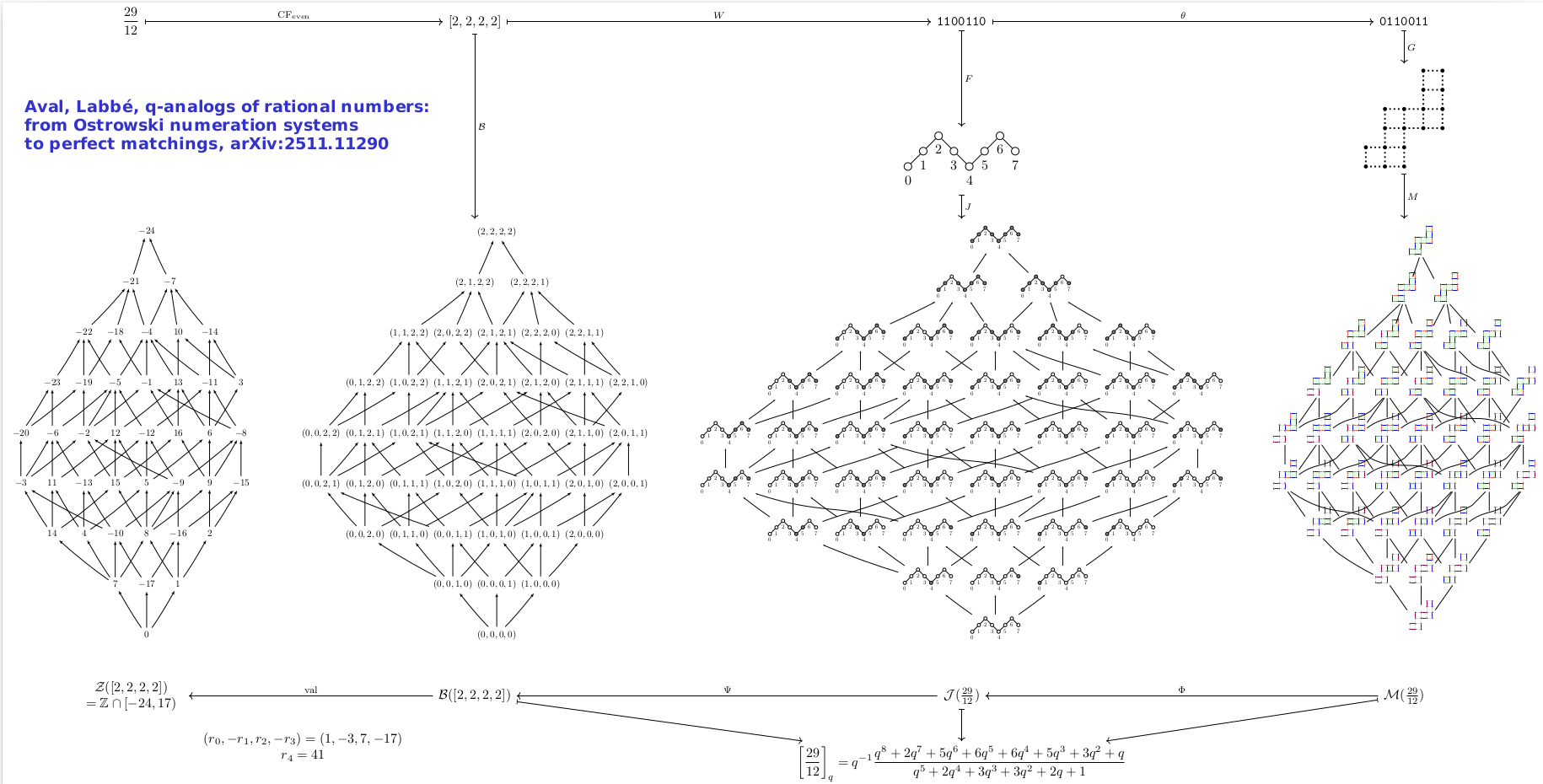
Here is the same Figure made for 29/12:
\(\left[\frac{29}{12}\right]_q=q^{-1}\frac{q^{8} + 2q^{7} + 5q^{6} + 6q^{5} + 6q^{4} + 5q^{3} + 3q^2 + q}{q^{5} + 2q^{4} + 3q^{3} + 3q^{2} + 2q + 1}\)
The above two images are available for download as pdf here:
- A pdf illustrating \([9/16]_q\)
- A pdf illustrating \([29/12]_q\)
- A 31 pages pdf of the first 31 rational numbers up to depth 4 in the Stern-Brocot tree (a phantom version of the same document to be completed as an exercise)
I plan to make by code public soon in my SageMath package slabbe in order for anyone to reproduce any of these figures for every positive rational number. Perhaps, I will do this during the next Sage Days in Montreal.
NOTE: There is a typo in our version v1 of the preprint available on arxiv. In the definition of the function F from binary words to fence posets, the letters 0 and 1 should be swapped: letter 1 means a up-step and letter 0 means a down step. We will fix the typo together with other changes to be made during the review process. The typo is strange because it means we are not consistent with the notation of the recent article of McConville, Propp and Sagan published in Forum of Math, Sigma. This is something which we will investigate further during the review process.
Propulsé par Blogofile
S'abonner au Flux RSS
et aux Commentaires.

This work by Sébastien Labbé is licensed under a Creative Commons Attribution-ShareAlike 4.0 International License.