A construction of the hat tilings by a Markov partition
26 mars 2026 | Mise à jour: 06 mai 2026 | Catégories: math | View CommentsOn October 3rd, 2025, in Montreal, Peter Selinger gave a talk at LaCIM in Montreal (where I am based this year in the French IRL CRM-CNRS laboratory) about the hex game. After lunch, I asked him to play against him. Since I needed to leave in about 30 minutes to give a colloquim at CRM at Université de Montréal, I thought playing againt Peter should not take too long as I would lose fast.
We ended up never even starting the hex game.
Peter was also short in time because he was also giving a second seminar the same day in the afternoon this time at McGill University about Quantum computing, his main research subject.
Peter asked me what was my talk about. I said aperiodic tilings associated to the metallic mean, etc. Then, he showed me a picture he recently made. Right away, I recognized the fractal shape in the partition of the internal space described by Baake, Gähler and Sadun for tilings by the meta-tiles T, H, P and F following the original terminology of Smith, Myers, Kaplan and Goodman-Strauss. I was wondering since then if we could use their partition to describe the hat tilings the same way I did it for Jeandel-Rao tilings. So, I asked Peter how he got the picture. Then he told me exactly what I was hoping for. Peter's construction is marvelous!
With the semester Illustration as a mathematical research technique currently taking place this winter at Institut Henri Poincaré, Paris, I thought it would be a good occasion to share Peter's discovery. Together, we have been preparing a preprint presenting a construction of the hat tilings by a Markov partition following the approach I used in my work on Jeandel-Rao tilings. The preprint is not ready yet to be posted on arxiv, but we publicly share our draft today, March 26th, 2026.
An important aspect of the construction is the choice made by Peter for the placement of the anchors for each tile. Anchors are widely and commonly called control point in the community, but since Peter is an expert on Bezier curves, the terminology of control point did not make sense for him. And maybe he has a (control?) point.
The partition discovered by Peter can be seen as a extension of what happens with Jeandel Rao tilings that I now explain visually with a DIY laser cut puzzle on top of a partition.
The talk at IHP on March 26 was recorded and will be available on the carmin.tv website.
UPDATE (April 24th, 2026): Our preprint is now online at arXiv:2604.20964.
Here is additional documents to produce hat tilings from the placement of a transparent grid on top of the partition. These DIY documents can be used for outreach activities (it works great!):
- solution_16x17.svg: a svg of a hat tiling to laser cut many hats
- grid-triangular-A4.pdf: the triangular grid in A4 format to be printed on acetate
- grid-triangular-letter.pdf: the triangular grid in letter format to be printed on acetate
- poster-partition-A3.pdf: the partition in A3 format
- poster-partition-A4.pdf: the partition in A4 format
- poster-partition-letter.pdf: the partition in letter format
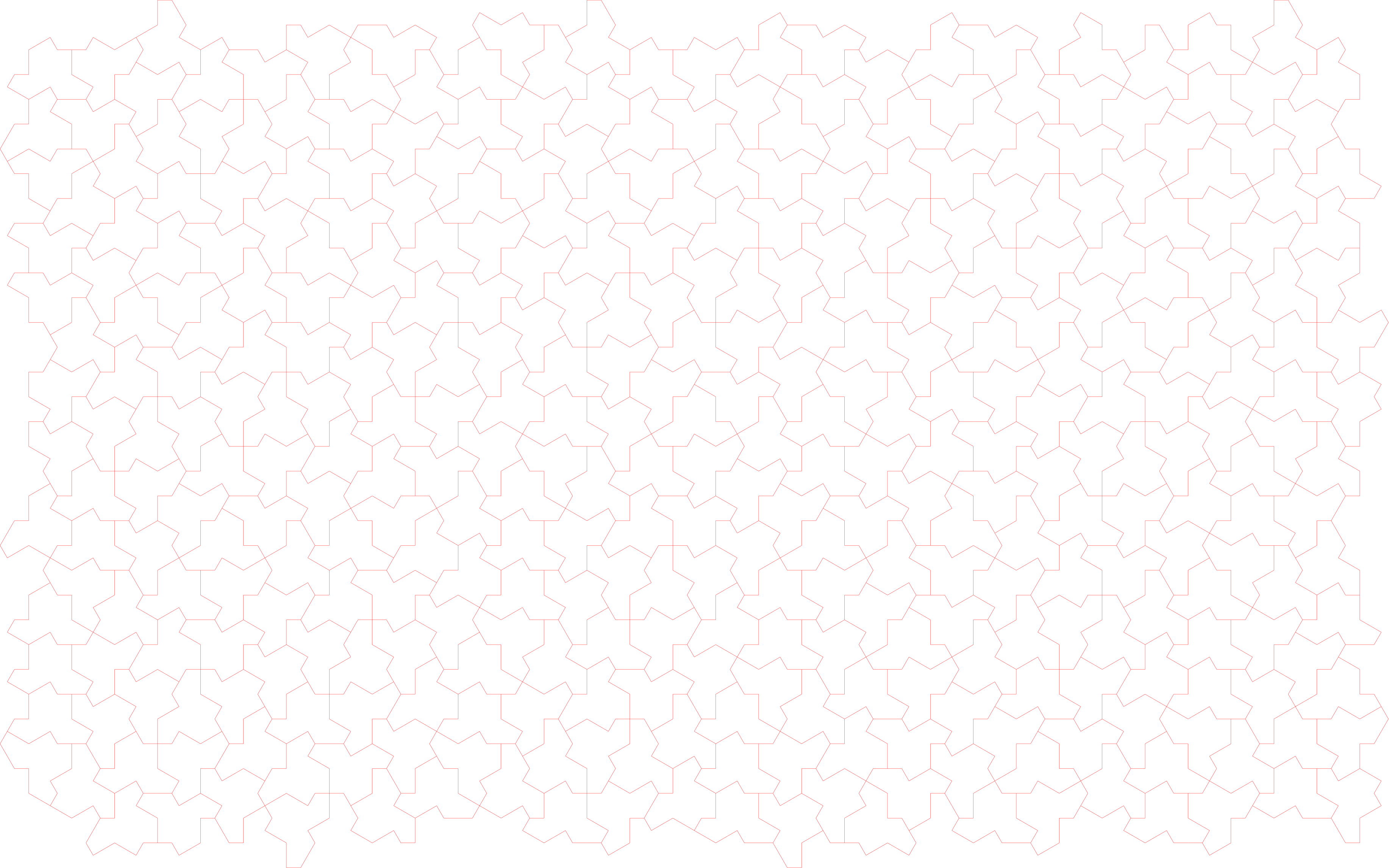
All of the above documents use \(2\sqrt{3}\) cm for 1 unit corresponding to 3 cm for the height of the equilateral triangles in the grid. This is the choice I have made in 2023 when I made my first laser cut of the hats.
Now, I think using 3 cm would be better for the unit (side length of the equilateral triangles). Maybe next time I laser cut 1000 hat tiles, I will use this smaller size instead. If I do this one day, I will upload these new documents here.
UPDATE (May 6th, 2026): My coauthor Peter Selinger made an applet to put tiles on top of the Markov partition:
Propulsé par Blogofile
S'abonner au Flux RSS
et aux Commentaires.

This work by Sébastien Labbé is licensed under a Creative Commons Attribution-ShareAlike 4.0 International License.